
Rug knot density is the number of individual knots woven into a specific area of a hand-knotted rug. It is usually measured in knots per square inch (KPSI). This measurement helps explain how closely a rug is woven and how much detail its design can hold.
When shopping for a fine hand-knotted rug, you may come across terms such as high knot count, fine weaving and KPSI. These terms can sound technical, especially if you are buying your first handmade rug.
However, understanding knot density is easier than it seems. A higher knot count can allow more detailed patterns, but it does not automatically make a rug better. Materials, craftsmanship, design, condition and weaving traditions also matter.
This guide explains what rug knot density means, how KPSI is measured and what to look for when comparing hand-knotted rugs.
What Is Rug Knot Density?
Rug knot density refers to the number of individual knots found within a measured area of a hand-knotted rug. The most common measurement used in the United States is knots per square inch, also known as KPSI.
Each knot is tied around the foundation threads during the weaving process. These knots create the pile and form the rug’s pattern.
A rug with more knots packed into one square inch has a higher knot density. A rug with fewer knots in the same area has a lower knot density.
For example:
A rug with 80 KPSI contains approximately 80 knots in each square inch.
A rug with 200 KPSI contains approximately 200 knots in each square inch.
A rug with 400 KPSI contains approximately 400 knots in each square inch.
The difference affects how much detail the weaver can create.
A higher knot density generally allows smaller design elements, finer curves and more detailed patterns. A lower knot density often works well for bold geometric patterns and simpler designs.
However, both can represent excellent craftsmanship when the construction suits the design.
What Does KPSI Mean in Rugs?
KPSI stands for Knots Per Square Inch.
It measures how many individual knots are present within one square inch of a hand-knotted rug.
The measurement is useful because it gives buyers a way to understand the fineness of a rug’s construction.
For example, imagine two rugs with similar dimensions and designs.
Rug A has 100 KPSI.
Rug B has 300 KPSI.
Rug B has three times as many knots per square inch. This can allow the weaver to create smaller details and more complex patterns.
However, the number alone does not tell you which rug is more beautiful, durable or valuable.
A well-made tribal rug with a lower knot count may be more desirable than a poorly made rug with a much higher count.
How Are Knots Counted in a Hand-Knotted Rug?
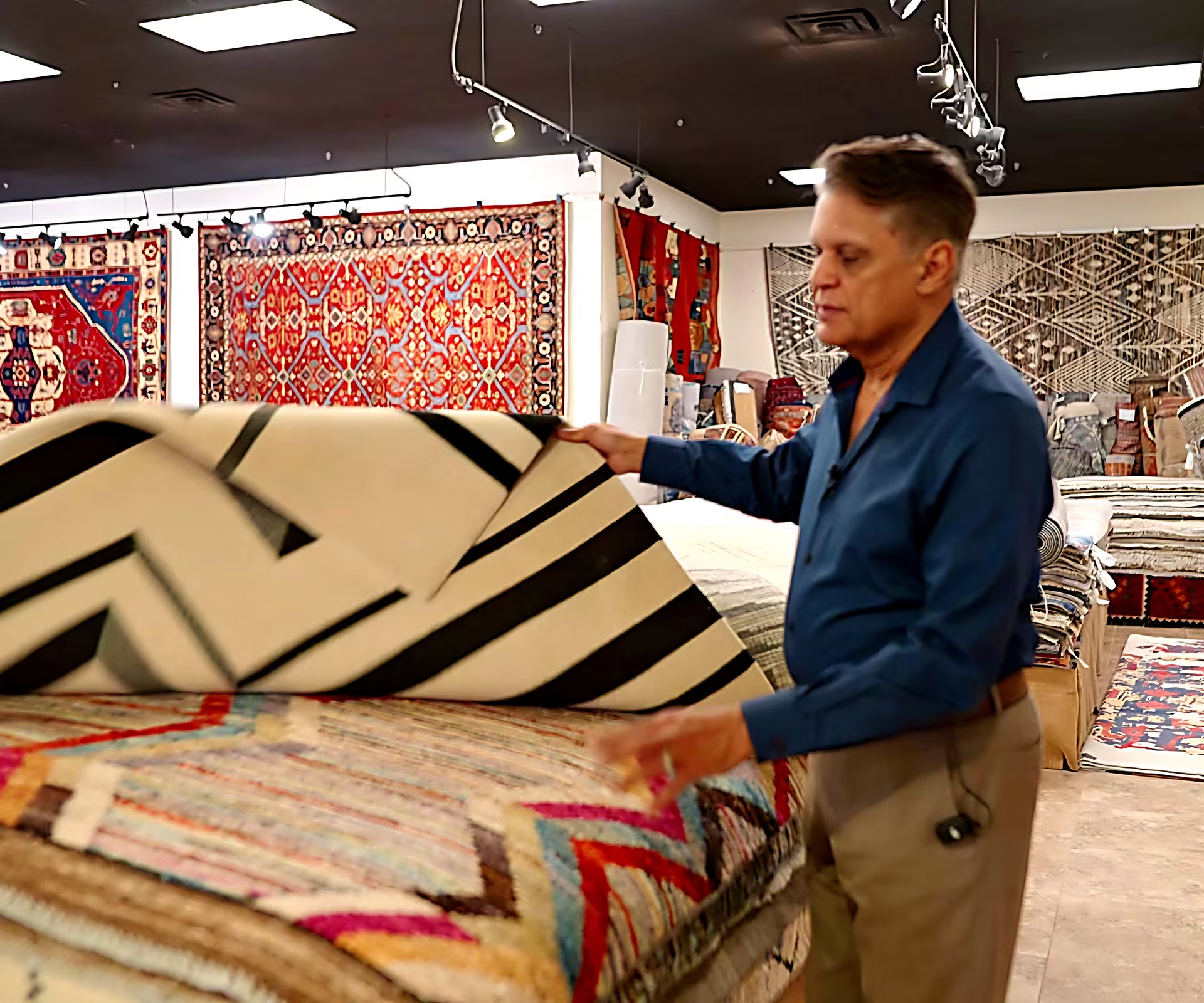
Knot density is usually examined from the back of the rug because individual knots are easier to see there.
The knots are arranged along the foundation threads, creating rows across the rug.
To calculate KPSI, you need to count the knots in both directions.
The basic formula is:
For example:
| Measurement | Knot count |
|---|---|
| Knots across one inch | 15 |
| Rows across one inch | 12 |
| Total KPSI | 180 |
Calculation:
This means the measured area contains approximately 180 knots per square inch.
The two directions do not always have the same number of knots. This is normal because the spacing of foundation threads can vary according to the rug’s construction.
How to Check Rug Knot Density Yourself
If you want to understand the knot count of a rug, follow these basic steps:
Turn the rug over carefully to examine its back.
Find a clear section where the individual knots are visible.
Place a ruler beside the knots.
Mark a one-inch section horizontally.
Count the knots across that section.
Count the knot rows vertically within another one-inch section.
Multiply the two counts.
Repeat in other areas to check whether the density is similar.
For example, if you count 14 knots across and 13 rows vertically, the estimated density is:
Note: This is a simplified inspection method. Rug construction and regional counting systems can affect the result. For a reliable comparison, ask the seller how the quoted KPSI was measured.
Different Levels of Rug Knot Density
Hand-knotted rugs are made in many different knot densities. The appropriate density depends on the rug’s origin, design, materials and weaving tradition.
Alyshaan’s rug-buying guidance gives several useful examples.
| Rug type | Approximate KPSI |
|---|---|
| Coarser tribal rugs | 40–80 |
| Fine Persian city rugs, including Tabriz and Kashan | 200–400 |
| Finest silk Qum rugs | Can exceed 800 |
These are examples, not universal grading standards. They should not be used as strict rules for every rug.
Alyshaan Fine Rugs Scottsdale
Low Knot Density Rugs
Low knot density rugs have fewer knots within each square inch.
They often feature bold patterns, larger geometric shapes and traditional tribal designs.
Their appearance can feel more organic because the individual design elements do not need extremely fine knotting.
Some advantages include:
Strong visual patterns.
Traditional geometric designs.
Distinctive handmade character.
Suitability for designs that do not require tiny details.
A lower knot count should not be confused with poor craftsmanship.
Medium Knot Density Rugs
Medium knot density rugs offer a balance between pattern detail and the visual character of the weave.
They can feature floral patterns, medallions, borders and more detailed decorative elements.
Many traditional Persian designs use knot densities that allow the weaver to create attractive details without making the entire pattern extremely fine.
High Knot Density Rugs
High knot density rugs contain many small knots within each square inch.
This construction allows weavers to produce intricate floral designs, fine curves and detailed decorative patterns.
Some fine Persian silk rugs, including Qum examples, can exceed 800 KPSI.
These rugs can require considerable skill and time to produce. However, high density should still be assessed alongside the materials, weaving quality and overall condition.
Why Does Knot Density Matter in Handmade Rugs?
Knot density matters because it helps explain the level of detail a weaver can achieve.
It also provides useful information about the construction of a hand-knotted rug.
Here are four important reasons to understand it.
1. It Affects Pattern Detail
One of the clearest effects of knot density is the level of detail in a rug’s design.
A higher knot count allows the weaver to create smaller decorative elements.
For example, a detailed Persian floral pattern may require finer knotting to produce smooth curves and carefully arranged flowers.
A bold tribal pattern may not need the same density because its geometric shapes are larger.
2. It Reflects the Complexity of Weaving
Higher knot density can require more individual knots within the same area.
This may increase the amount of work needed to complete a rug.
The design, size, weaving speed and number of artisans also affect production time.
Therefore, knot density can help explain some of the differences between the construction of fine and coarser handmade rugs.
3. It Can Influence Price
Knot density is one factor that may influence a rug’s price.
A rug with intricate detailing and high knot density can require more skilled labour.
However, price also depends on:
Wool or silk quality.
Dye quality.
Rug size.
Design complexity.
Country and region of origin.
Age and condition.
Overall craftsmanship.
This is why two rugs with similar KPSI figures can have very different prices.
4. It Helps Buyers Compare Similar Rugs
KPSI becomes particularly useful when comparing rugs with similar designs, materials, sizes and origins.
For example, if two Persian rugs use similar wool and have similar patterns, knot density can help explain differences in the fineness of their construction.
It should be used as one part of the comparison rather than the only deciding factor.
Does Higher Knot Density Mean a Better Rug?
No. A higher knot count does not automatically mean a better-quality rug.
This is one of the most common misunderstandings among handmade rug buyers.
Knot density measures the number of knots within a specific area. It does not directly measure the quality of the wool, the strength of the foundation, the skill of the weaver or the condition of the finished rug.
Consider two examples.
Rug A: A traditional tribal rug with 70 KPSI, carefully selected wool and an attractive geometric design.
Rug B: A rug with 300 KPSI but lower-quality materials and inconsistent craftsmanship.
Rug A may be more desirable to a buyer who values traditional tribal design and natural materials.
Rug B has a higher knot count, but that alone does not make it the better purchase.
Alyshaan also emphasizes that some tribal and antique rugs with lower knot counts can be highly prized.
Alyshaan Fine Rugs Scottsdale+1
Other Factors That Determine Rug Quality
| Quality factor | Why it matters |
|---|---|
| Wool quality | Affects softness, resilience and long-term wear |
| Silk quality | Adds shine and allows fine detailing |
| Foundation | Supports the rug’s overall structure |
| Dye quality | Influences colour depth and appearance |
| Weaving skill | Affects consistency and construction |
| Design | Determines the visual character of the rug |
| Condition | Helps establish its current usability and value |
A good handmade rug brings these elements together.
How Does Knot Density Differ Between Persian and Tribal Rugs?
Persian and tribal rugs often have different design styles and weaving characteristics.
Persian city rugs are frequently associated with detailed floral designs, central medallions and intricate borders. Many examples use finer knotting to create these patterns.
Tribal rugs often feature larger geometric shapes, bold lines and traditional motifs. These designs can work beautifully with lower knot densities.
However, these are general observations rather than fixed rules. Both Persian and tribal weaving traditions include rugs with different levels of detail and construction.
The important point is to judge each rug according to its design and weaving tradition.
For a better understanding of construction, explore Alyshaan’s guide to fine area rug construction.
What Is the Relationship Between Knot Density and Rug Durability?
Knot density and durability are related to rug construction, but they are not the same thing.
A higher knot density can create a more closely woven structure. However, durability also depends on the quality of the fibres, the foundation, the pile and how the rug is used.
For example, a fine silk rug may have a very high knot count but still require more careful placement than a sturdy wool tribal rug.
Wool is commonly chosen for its resilience and practical use in everyday spaces. Silk is valued for its shine and fine detail but is generally better suited to lower-traffic areas.
A rug’s durability should therefore be judged by looking at its complete construction rather than relying on KPSI alone.
Alyshaan Fine Rugs Scottsdale+1
Why Do Different Rug-Making Regions Use Different Knotting Systems?
Not all rug-making traditions measure knot density in exactly the same way.
Some regional systems use measurements based on the number of knots or rows across a particular length instead of directly reporting knots per square inch.
For example, the Persian term raj is associated with counting knot rows along a traditional unit of length.
When comparing regional measurements, it is important to understand what the number represents before making a direct comparison.
Encyclopaedia Iranica+1
This is particularly important when comparing rugs from Iran, Turkey, India, Pakistan and Afghanistan.
A seller should be able to explain the measurement system used for a quoted knot count.
Common Mistakes Buyers Make When Understanding KPSI
Knowing how knot density works can help you avoid several common buying mistakes.
Assuming the Highest KPSI Is Always Best
A high knot count may allow fine detailing, but it does not guarantee better materials or craftsmanship.
Comparing Different Rug Traditions Without Context
A tribal rug and a fine Persian city rug may have very different construction goals.
Their knot counts should not be compared without considering their origins and designs.
Ignoring Material Quality
A rug’s wool, silk and foundation play important roles in its overall quality.
A high KPSI figure cannot compensate for poor materials.
Believing Every Seller Uses the Same Measurement
Regional knot-count systems can differ. Always ask how the figure was calculated.
Judging a Rug Only by Its Appearance
The front of a rug shows its design, but the back can reveal important construction details.
Inspect both sides and ask about materials, origin and workmanship.
How to Choose a Hand-Knotted Rug Using Knot Density
If you are planning to buy a fine handmade rug, use KPSI as a helpful starting point.
Follow these practical recommendations:
Start with the design: Decide whether you prefer bold geometric patterns or fine floral details.
Ask about knot density: Request the KPSI figure and how it was measured.
Check the materials: Find out whether the rug uses wool, silk or a combination.
Inspect the back: Look for visible hand-tied knots and the pattern reflected on the reverse.
Consider the weaving tradition: Compare rugs from similar origins and construction styles.
Evaluate the condition: Check for wear, repairs, fading and damaged edges.
Compare overall quality: Consider the complete rug rather than choosing based on one number.
At Alyshaan Fine Rugs, buyers can explore a range of genuine hand-knotted rugs and receive assistance when comparing construction, materials and design.
You can also explore the Alyshaan rug collection to discover different rug styles.
Why Expert Guidance Matters When Comparing Fine Rugs
Understanding knot density is useful, but evaluating a handmade rug involves much more than counting knots.
A trained rug professional can help identify the materials, construction, origin and condition of a piece. They can also explain whether its knot density is suitable for the design and weaving tradition.
This can be especially helpful when comparing antique Persian rugs, tribal pieces and fine silk rugs.
Alyshaan Fine Rugs offers a collection of hand-knotted rugs, along with custom rug design and professional rug services.
For buyers who want to understand a rug before making a decision, expert guidance can make the process much easier.
Conclusion
Rug knot density is an important way to understand the construction of a hand-knotted rug. Measured in knots per square inch, KPSI explains how many individual knots are woven into a specific area.
Higher knot density generally allows finer patterns and more detailed designs. However, it does not automatically mean better quality, greater durability or higher value.
Materials, weaving skill, design, origin and condition all matter.
The best way to evaluate a fine handmade rug is to consider its complete craftsmanship rather than focusing on a single number. Once you understand KPSI, you can compare different rugs with greater confidence and choose one that suits your home and personal style.
FREQUENTLY ASKED QUESTIONS
1. What is a good knot density for a handmade rug?
There is no single ideal knot density for every handmade rug. Tribal rugs can have around 40–80 KPSI, while fine Persian city rugs may reach 200–400 KPSI. The right density depends on the rug’s design, materials and weaving tradition.
2. Is 200 KPSI good for a Persian rug?
Yes. A 200 KPSI count can represent fine construction in a Persian rug. However, you should also consider the wool or silk quality, design, foundation and weaving skill.
3. Does higher KPSI make a rug more expensive?
It can contribute to a higher price because fine knotting may require more labour. However, size, materials, origin, rarity, design and condition also influence the price.
4. Can I count the knots on a rug myself?
Yes. Turn the rug over, identify a clear one-inch section, count the knots across and the rows vertically, then multiply the two figures. Repeat in other areas for a more reliable estimate.
5. What is the difference between knot density and weave quality?
Knot density measures how many knots are present in a particular area. Weave quality considers the complete construction, including knot consistency, foundation, materials and workmanship.
6. Do silk rugs have higher knot density than wool rugs?
Some fine silk rugs have very high knot densities because silk allows intricate detailing. However, not every silk rug has a higher count than every wool rug. Construction and design determine the actual density.
